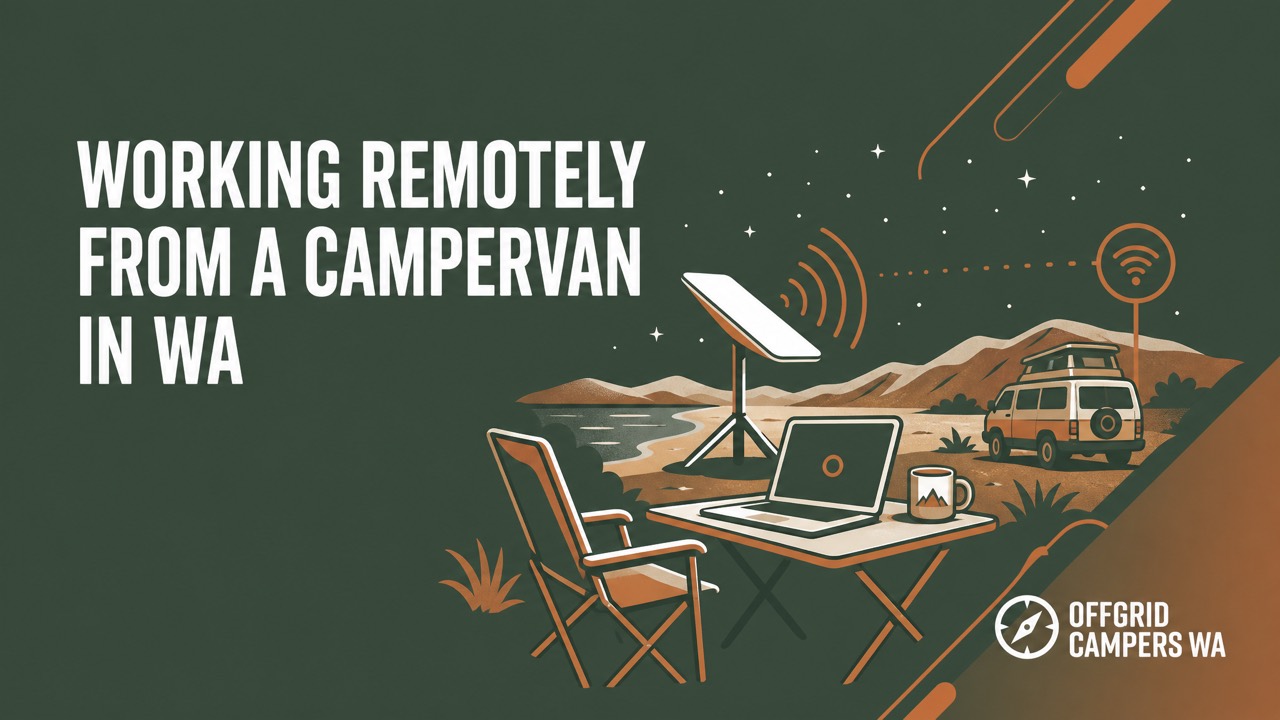
Working from a camper in Western Australia used to mean planning your week around the next town with a phone signal. That has changed. Between satellite internet and a properly set-up power system, you can hold down a normal work week from a quiet beach or a bush camp. The catch is that WA has its own rules, and the people who struggle are usually the ones who treated it like a city with nicer views. Here is what it actually takes.
Can you actually get online?
Yes, but not on your phone alone. Near the bigger towns a Telstra SIM and a hotspot will carry email and the odd call. Push past the edge of town and that falls apart fast, which is most of the interesting parts of WA.
The fix is satellite. The Starlink Mini is a compact dish with the router built in, so it sets up in a couple of minutes and broadcasts Wi-Fi to your laptop and phone like a home connection. Speeds are typically 100 to 200 Mbps with low enough latency for video calls, which is the part that matters when you are on camera for a stand-up at 9am. If you want the full comparison of options, our off-grid internet options guide covers Telstra, boosters and satellite side by side.
Power: running a work day off solar
A laptop is a light load. The problem is everything running at once: laptop, phone, the dish, the fridge, maybe a second screen. That is where people flatten a battery by lunchtime.
Our campers run 300Ah of lithium with 200W of solar, which carries a normal work day plus the fridge and charging without a powered site, as long as you are sensible. The Starlink Mini itself only draws around 25 to 40 watts, less than most people expect. Run the dish when you need it rather than around the clock, park where the panels get sun, and you will not think about the battery. There is more detail in our off-grid power tips.
Where to base yourself
Match the camp to the work week, not the other way around.
If you have a heavy week of meetings, base near a town with good coverage and use Starlink as backup. If the week is mostly heads-down work, you can go properly remote, you just need a clear view of the sky for the dish, so a wide open camp beats a tight spot under dense trees. The most self-sufficient setup for that is the Offgrid Wanderer 2.0, which carries its own water and shower so you are not driving back to town every second day.
The daily rhythm that works
WA distances are the real trap, not the driving. A “quick” hop between spots can be three hours, so do not plan to drive and deliver on the same day.
The time zone actually helps. WA runs on AWST, which is well ahead of the eastern states and lines up neatly with Asia and with early mornings in Europe. A common rhythm is to work the morning while the light is cool, break in the heat of the afternoon, then move camp or get outside late. In summer the middle of the day is for shade, not a laptop in a hot van.
What can still go wrong
Be honest with yourself before you commit a deadline to a remote camp:
Heavy cloud and thick tree cover degrade the dish, so a forest gully is a worse office than an open paddock. Extreme heat slows everyone down, including your gear. And there are no powered sites out bush, so if your week cannot survive a flat battery or a cloudy afternoon, build in a buffer or stay closer to town. Satellite internet makes remote work possible in WA. It does not make it bulletproof.
The simple setup
You do not need to buy and rig any of this for one stint on the road. We offer Starlink Mini hire on its own or fitted to a camper, on one unlimited plan with no data caps, and the campers come with the battery and solar already sorted. Tell Dorian what your work week looks like and he will tell you honestly whether your plan holds up, or where to tighten it.