The question we get most before a Coral Coast trip is some version of “will my phone work up there?”. Short answer: not for long. Telstra carries you through the towns, then the map goes white. Whether that matters depends entirely on where you are headed, so before you decide between a SIM and Starlink, look at the route, not the brand. Here is how the two actually compare for a WA trip.
The short answer
Telstra is the best phone network for regional WA, and for a lot of trips it is enough on its own. Starlink is what you add when you need real internet where there is no tower at all. They are not really rivals: one covers towns and main roads, the other covers the gaps. If your trip stays near the coast and the bigger towns, lean on Telstra. If it runs through remote stretches, or you need to work, take Starlink as well.
What Telstra covers in WA, and what it doesn’t
Telstra has the widest mobile footprint in regional WA by a clear margin. If you are relying on a phone or a hotspot out bush, a Telstra or Telstra-network SIM is the one to have. Optus is fine along the coast and in regional towns. The smaller resellers ride the same networks but sometimes deprioritise data in busy remote areas.
The catch is that even the best mobile coverage runs out fast once you leave the highway. Long stretches of the Coral Coast, the country between Carnarvon and Exmouth, and the inside of most national parks simply have no tower to reach. Check your route on the Telstra coverage map before you assume you will be connected, and treat the edges of the map as optimistic.
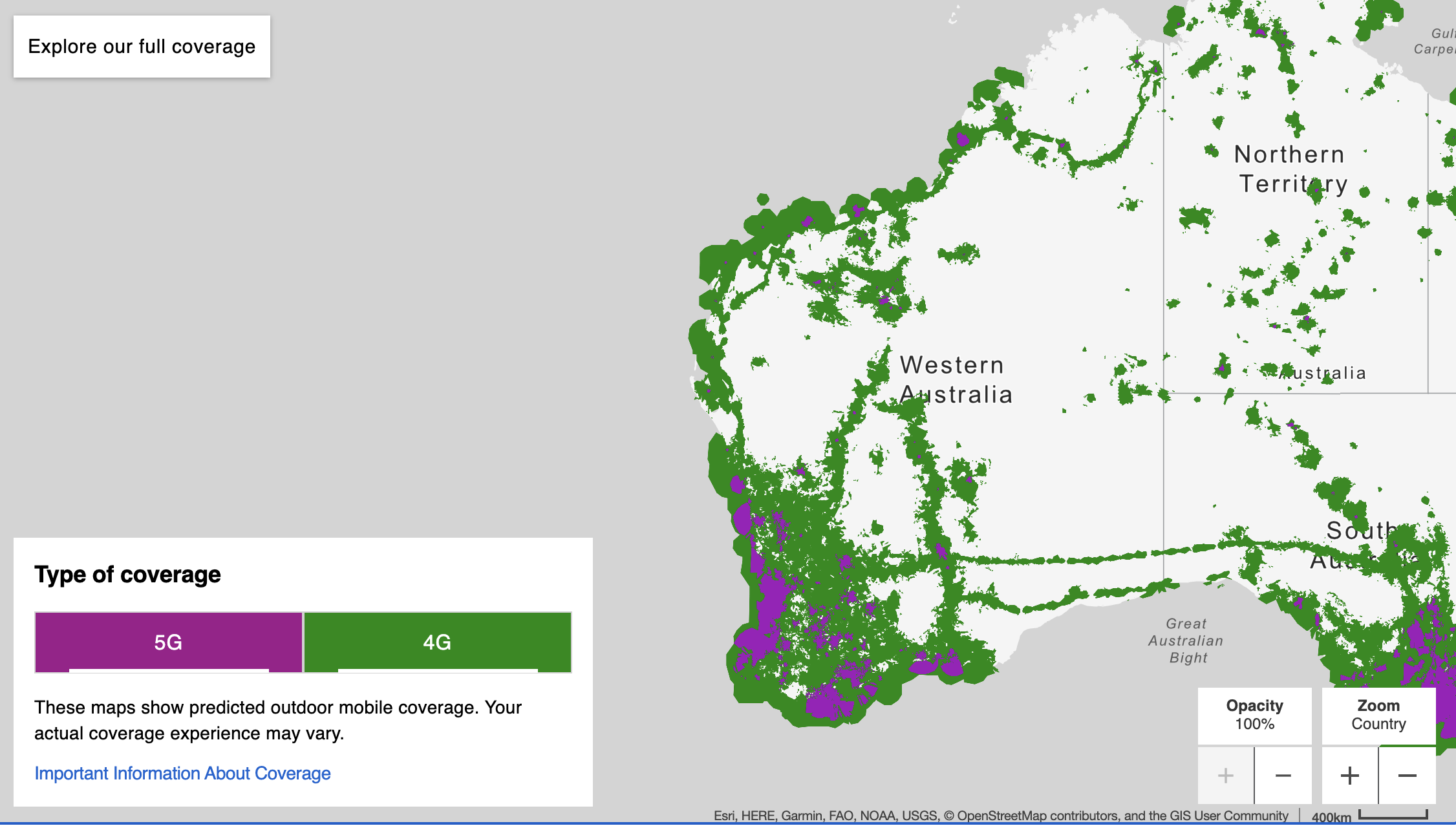
Source: Telstra mobile coverage map. The white areas are where a phone has no tower to reach, which is most of WA by area.
A signal booster can pull in a faint, distant tower, so it helps on the fringe of coverage. It cannot create a signal where there is no tower at all, so it does nothing in a true dead zone.
Where Starlink takes over
Starlink connects to low-orbit satellites instead of a phone tower, so it works almost anywhere with a clear view of the sky. Speeds are typically 100 to 200 Mbps, with low enough latency for video calls. That is a different world from a booster straining for a distant signal. The one rule is the sky: park away from heavy tree cover and it just works.
That makes it the answer for the places a phone gives up: Karijini, Cape Range and Ningaloo, Cape Le Grand near Esperance, Coral Bay, and the long quiet stretches of the Coral Coast. If staying online matters for work, family or peace of mind, that is where it earns its keep. Our off-grid internet options guide goes deeper on the trade-offs.
Clearing up Mini and Roam
One point that trips people up: the Starlink Mini is hardware, not a plan. It is a compact, portable dish with the router built in, sized for travel. Roam is the service plan category that lets a dish work while you move around. You run a Roam plan on the Mini, so it is not a choice between the two.
For a WA road trip the Mini is the practical kit: light, low power, quick to set up, and easy to stow when you are driving. If you want the full setup walk-through, see our Starlink road-trip guide.
Power: can your camper run it?
This is where people overthink it. The Mini draws roughly 25 to 40 watts, less than the standard dish. On a camper with a decent battery and solar that is an easy load. Our campers run 300Ah lithium with 200W of solar, which carries the Mini alongside the fridge, lights and charging through normal daily use. Run it when you need it rather than around the clock and you will barely notice it on the battery. There is more on this in our off-grid power tips.
So which do you actually need?
It comes down to where you are going. A sealed south-west loop, Margaret River, the Great Southern, the Esperance towns, rarely needs more than a Telstra SIM. You will have signal in and around the towns, and the gaps between them are short enough to not matter.
That said, get off the beaten path and even the south-west will surprise you. We recently took our new Offgrid Wanderer 2.0 down to test the setup, and the coastline around Albany and Esperance had real dead patches once we left the main roads. Telstra still beat Optus comfortably, but plenty of the best coastal spots had no signal at all, and that is exactly where the Starlink antenna earned its place.
The Coral Coast is the opposite. On the run to Exmouth and Coral Bay the signal drops out for long stretches, and the campsites worth stopping at sit well outside coverage, so plan on Starlink. The same goes for park stays like Karijini, Cape Range and Cape Le Grand, where most campgrounds have no usable signal at all.
Working on the road is the one case with no grey area. A hotspot near town will do for email, but a full work day from a quiet camp is not something Telstra will carry. That is a Starlink trip, every time.
If you are not sure where your route sits, send Dorian the plan and he will tell you honestly whether you need it.
The simple option
You do not have to buy a dish or sign up to a plan for one trip. We rent a Starlink Mini on its own or added to a camper, on one unlimited plan with no data caps. The kit is the Mini dish, a 240V power supply, a 12V vehicle adapter, a 15m cable and a stand, so you can set it up at camp or run it from the vehicle. Pickup is from our Cloverdale depot in Perth, use is within WA, and the longer you hire the cheaper the daily rate.
For most trips the honest answer is both: a Telstra SIM for the towns, and a Starlink Mini for everywhere else.